
Two Very Different Problems
People arrive at a well contractor's site in one of two states, and they need completely different things. So we have split the site rather than making you guess which half is for you.
No water. Low pressure. Strange noises.
Start with the free troubleshooter. It walks the same sequence we would on the phone, and it genuinely does resolve a good proportion of calls before anybody drives out — because the most common cause of no water is a tripped breaker.
- No-water troubleshooter — the flagship
- No water in the house
- Pump runs constantly
- Low water pressure
- Sputtering taps / air in the lines
- Well ran dry
New well. New lot. Buying a house.
Drilling is a range, not a number, and anyone quoting firm footage before starting is guessing. Here is what actually drives the cost, what yield depends on, and what a proper well inspection covers.
- Well cost estimator
- Well drilling, deepening & hydrofracking
- NH well costs & depths reference
- Buying a house with a well
- Inspection & water testing
- Hydrofracking a low-yield well
Why Depth and Yield Are Not the Same Question
Almost every well in this region is a drilled bedrock well, and understanding the six parts below explains most of what goes wrong — and why no honest driller will give you a fixed footage before starting.
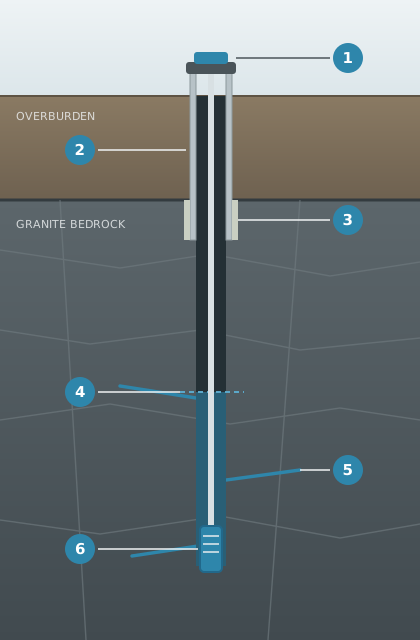
- 1. Wellhead & sanitary capThe only part you can see. The cap keeps surface water, insects and debris out of the flue of the well. A damaged or missing cap is a direct contamination route.
- 2. Steel casingDriven through the overburden — the loose glacial till above the rock — and sealing the well off from shallow groundwater.
- 3. Grout seal into bedrockWhere the casing is sealed into the top of the granite. This is what separates your water from everything happening at the surface.
- 4. Static water levelWhere the water stands when the pump is off. Frequently far above the pump — a 400-foot well does not mean 400 feet of water.
- 5. Fractures in the graniteThis is where the water actually comes from. Not from a pool at the bottom — from cracks the bore happens to intersect. Which is why yield is unpredictable and depth alone tells you very little.
- 6. Submersible pumpHanging on the drop pipe near the bottom. Commonly lasts 15–25 years, and is usually killed by something else failing first.
Three Things Worth Knowing Before You Call Anyone
If your pump is running and no water is coming out, switch it off. Running a pump dry destroys it, sometimes within minutes. Whatever is wrong, the pump running against nothing is making it worse and more expensive by the minute. Turn off the breaker, then work out what is happening.
The cheapest part on your system is killing the most expensive one
A pressure tank holds an air charge that acts as a cushion, so you can draw a glass of water without starting the pump. When that charge is lost, every draw starts the pump, which runs for a couple of seconds and stops. That is short-cycling, and motors wear out from starting rather than running. A short-cycling system can put a pump through more starts in a month than a healthy one sees in a year.
The test takes ten seconds: run a tap and listen. Steady run then stop is healthy. Rapid on-off-on-off is short-cycling, and the tank — at $400 to $1,200 — is quietly destroying a pump that costs more to replace. A great many pump replacements in this region should have been tank replacements a year earlier.
Sputtering that recovers overnight is the well, not the pump
If taps run fine in the morning, start spitting air by evening, and are fine again next day, that is a yield pattern. The well is being drawn down faster than the fractures refill it. Fitting a bigger pump to a low-yield well simply empties it faster and costs you the pump. The real answers are hydrofracking, storage, or in some cases deepening — and they are worth comparing properly rather than guessing at.
Nobody is testing your water
Private wells in New Hampshire are not monitored by any authority. Testing is entirely the owner's responsibility, and the things most worth testing for — arsenic, radon in water and uranium, all naturally occurring in this state's granite — have no taste, no smell and no appearance. Water can look and taste perfect and still be worth testing. See the testing resources for accredited laboratories.
Work It Out Before You Call
No-Water Troubleshooter
The same sequence we would walk through on the phone. Tells you the likely cause, how urgent it is, and what to check before anyone drives out. It genuinely resolves some calls entirely, which is the point.
Well Cost Estimator
New well, deepening or hydrofracking, with a depth slider and an honest range out the other end — built on Lakes Region per-foot rates rather than a national average.
Common Questions
How much does a new well cost in New Hampshire?
Drilling runs roughly $30–$70 per foot, and a typical Lakes Region bedrock well is 200–500 feet. The NH average for a new drilled well is around $14,400, and a complete system with pump, tank and connection generally lands between $3,000 and $15,000 depending on scope. Use the estimator to narrow it, and see the cost and depth reference for the detail.
Why does my pump turn on and off rapidly?
That is short-cycling, and it is almost always a pressure tank that has lost its air charge. Without that cushion every draw of water starts the pump for a couple of seconds. Motors wear from starting rather than running, so it destroys pumps — and the tank costs a fraction of the pump it is killing. Worth dealing with this week rather than next year.
What should I check first if I have no water?
The breaker for the well pump. It is the single most common cause and it is free to rule out. Then look at the pressure gauge on the tank and note the reading. If the pump is audibly running but nothing is coming out, switch it off — running dry destroys pumps. The troubleshooter walks the full sequence.
How deep will my well need to be?
Commonly 200–500 feet in this region, deeper on hill ground in towns like Sanbornton, Bristol and Tuftonboro than in valley ground around Tilton or along the Pemigewasset. But depth is not yield: water in granite moves through fractures, so a well that hits a good one at 240 feet can out-produce a neighbour's at 420. Anyone quoting firm footage before drilling is guessing.
How long should a well pump last?
A submersible commonly runs 15–25 years. What shortens it is short-cycling from a failed pressure tank, sediment in the water, and repeated dry running. Most pumps that die early were killed by something cheaper that nobody checked.
Should I test my well water, and for what?
Yes, and nobody else will. Bacteria and nitrate annually; a fuller panel including arsenic, radon and uranium every few years or whenever something changes. Those three occur naturally in NH granite and none of them affects taste, smell or appearance — which is exactly why testing exists.
Twenty Lakes Region Towns
Each town page covers the local ground, typical drilled depths, and what actually fails there.